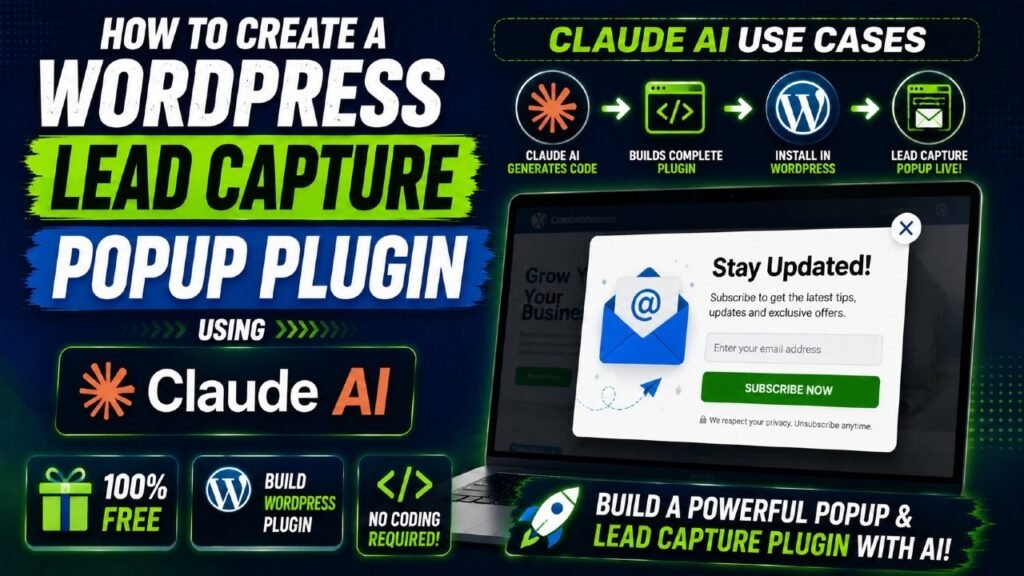
What if you could build a fully functional WordPress lead capture popup plugin from scratch — without writing a single line of code? That is exactly what Claude AI makes possible. In this step-by-step guide, you will see how to use Claude AI to create a professional-grade WordPress popup plugin complete with exit intent detection, scroll depth triggers, timed delays, customizable lead forms, database storage, admin management pages, and CSV export — all packaged as an installable .zip file ready to upload directly from your WordPress admin.
Whether you are a blogger, freelancer, agency owner, or business owner with zero PHP experience, this guide will show you how powerful Claude AI really is as a real-world WordPress development tool. By the end, you will have everything you need to build, install, and use your own custom WordPress lead capture popup plugin — built entirely with AI.
Watch step by step video tutorial: https://youtu.be/8XynlIU0Y68
Table of Contents
What Is a WordPress Lead Capture Popup Plugin?
The Role of Popups in Lead Generation
A WordPress lead capture popup plugin is a tool that displays an overlay form to website visitors, encouraging them to submit their contact information — typically their name, email address, and sometimes phone or company details. When used correctly, popup plugins are one of the most effective lead generation tools available, consistently outperforming static sidebar forms and inline opt-ins.
Research across digital marketing studies shows that well-timed popups can achieve conversion rates between 3 and 11 percent, far exceeding the 1 to 2 percent typical of standard embedded forms. The key word is “well-timed” — the difference between an effective popup and an annoying one comes down to when it appears, who sees it, and how it is designed.
Types of Popup Triggers
Modern WordPress lead capture popup plugins use behavioral triggers to show popups at the most relevant moment:
- Exit Intent — detects when the mouse cursor moves toward the browser’s close or back button and fires the popup just before the visitor leaves
- Timed Delay — displays the popup after the visitor has spent a set number of seconds on the page
- Scroll Depth — triggers the popup when the user has scrolled past a defined percentage of the page content
- Click Trigger — opens a popup when a visitor clicks a specific button, link, or image
- Page Load — shows the popup immediately when the page finishes loading
Why Use Claude AI to Build WordPress Plugins?
Claude AI as a WordPress Development Partner
Claude AI, developed by Anthropic, is one of the most capable AI coding assistants available today. Unlike simpler code generators, Claude AI understands complex, multi-file project structures and can produce entire WordPress plugins — complete with PHP backend logic, JavaScript frontend behavior, CSS styling, and database integration — from a single detailed prompt.
What sets Claude AI apart for WordPress development is its ability to handle long-context conversations. You can describe a complex plugin with dozens of features and Claude AI will produce organized, commented, standards-compliant code across multiple files — all without you needing to understand a single line of PHP.
Key Advantages of Building with Claude AI
- No coding experience required — describe what you want in plain English and Claude AI writes the entire plugin
- Dramatically faster development — what a developer might spend days building, Claude AI produces in minutes
- Multi-file project support — Claude AI generates proper plugin folder structures with separate files for admin, frontend, AJAX handlers, and database management
- Instant bug fixing — describe any error or unexpected behavior and Claude AI diagnoses and resolves it on the spot
- Iterative development — add new features simply by asking Claude AI to extend the plugin
- Clean, commented code — Claude AI follows WordPress coding standards and best practices
- Complete ownership — the generated plugin is yours to use, modify, and deploy on any number of sites
- Cost savings — avoid developer fees that can reach thousands of dollars for a custom plugin build
Claude AI vs. Other AI Tools for WordPress
Among AI coding tools, Claude AI stands out for WordPress development specifically because of its strong understanding of architectural decisions and its ability to handle the WordPress hook system, nonce security, and database interactions correctly. Tools like GitHub Copilot excel at autocomplete within a code editor, while Claude AI shines at generating complete, structured plugin codebases from natural language descriptions — making it the better choice for building a WordPress lead capture popup plugin from scratch.
Features of the AI-Built WordPress Popup Plugin
Popup Trigger System
The WordPress lead capture popup plugin built with Claude AI includes three powerful trigger mechanisms:
- Exit Intent Popup — monitors mouse movement and fires the popup when the cursor moves toward the top of the browser window, catching visitors just before they leave
- Timed Delay Popup — shows after a configurable number of seconds, giving visitors time to engage with your content before seeing the popup
- Scroll Depth Trigger — activates when the visitor scrolls past a set percentage of the page, targeting engaged readers who are most likely to convert
Fully Customizable Lead Forms
Each popup includes a flexible form builder with the following configurable fields:
- First Name and Last Name
- Email Address
- Phone Number
- Company Name
- Website URL
- Message
Every field can be independently enabled or disabled, marked as required or optional, and given custom labels and placeholder text — all from the WordPress admin settings page.
Advanced Display Conditions
The plugin supports granular display conditions, giving you precise control over which visitors see each popup:
- Specific pages or posts
- Homepage only
- Posts within a specific category
- Pages whose URL contains a specific keyword
- Logged-in users only or logged-out visitors only
- Desktop visitors only or mobile visitors only
Design, Lead Management, and Security
- Beautiful Popup Design — fully customizable colors, headline, sub-headline, body text, image, and CTA button text
- Cookie Suppression — prevents the popup from appearing again for a configurable number of days after a visitor dismisses it
- Lead Storage — all form submissions saved to a custom WordPress database table
- Admin Leads Page — view all captured leads in the WP Admin with pagination support
- CSV Export — download all leads as a spreadsheet at any time
- Nonce-Secured AJAX — fast and secure form submission without a full page reload
What You Need Before You Start
Required Tools and Accounts
Before building your WordPress lead capture popup plugin with Claude AI, make sure you have the following:
- A Claude AI account — sign up at claude.ai. A free account can handle the task, but a Pro or Max subscription provides a larger context window and better handling of complex, multi-file code generation.
- A local WordPress development environment — install WordPress Studio (free from WordPress.com) or LocalWP on your computer. Never develop or test AI-generated code directly on a live website.
- A text editor or IDE — tools like Visual Studio Code help you review, organize, and modify the generated plugin files if needed.
- Basic WordPress admin knowledge — you should know how to install a plugin from a .zip file and navigate the WordPress admin dashboard.
Optional but Helpful
- Familiarity with WordPress plugin structure — knowing that plugins live in /wp-content/plugins/ and that the main file uses a specific header format helps you verify what Claude AI generates
- Git or another version control system — useful for tracking changes as you iterate on the plugin with Claude AI
How to Prompt Claude AI to Create Your Popup Plugin
The Art of Effective Plugin Prompting
The quality of your Claude AI-generated WordPress plugin depends almost entirely on the quality of your initial prompt. Vague instructions produce incomplete code; detailed, specific instructions produce a complete, working plugin. Think of writing your prompt the way you would write a project brief for a developer — the more detail you provide upfront, the less back-and-forth you need.
What to Include in Your Plugin Prompt
A strong prompt for generating a WordPress lead capture popup plugin should include:
- The plugin name and its main purpose
- The exact PHP file and folder structure you want Claude AI to create
- A list of every trigger type (exit intent, timed delay, scroll depth) with the JavaScript logic you expect
- The form fields you need, whether they are optional or required, and how they should be stored
- The admin settings page layout, including how each popup is configured
- The database table structure for storing leads
- How AJAX form submission should work, including nonce verification
- The display conditions logic
- Cookie suppression behavior
- The admin leads page layout and CSV export function
- A request for clean, commented code following WordPress coding standards
Example Starter Prompt
Here is an example of how to open your conversation with Claude AI for building a WordPress popup plugin:
“Build a complete WordPress plugin called WP Lead Popup Pro. The plugin should have the following files: main plugin file, admin settings page (PHP), frontend popup display (PHP), AJAX handler (PHP), admin JavaScript, frontend JavaScript, admin CSS, and frontend CSS. Features include: exit intent popup trigger, timed delay popup trigger, scroll depth popup trigger, multiple popup support with individual settings, customizable form fields (first name, last name, email, phone, company, website, message — each can be enabled/disabled and set as required/optional), display conditions (specific pages, homepage, category, URL keyword, logged-in/out status, device type), popup design settings (colors, headline, sub-headline, body text, image, button text), cookie suppression with configurable days, lead storage in a custom database table, admin leads page with pagination, CSV export button, and nonce-secured AJAX. Follow WordPress coding standards. Write clean, commented code.”
That single detailed prompt gives Claude AI everything it needs to generate a complete, well-structured plugin without major gaps.
Step-by-Step: Building the WordPress Popup Plugin with Claude AI
Step 1 — Open Claude AI and Start Your Conversation
Go to claude.ai and start a new conversation. Paste your detailed plugin prompt directly into the chat. Claude AI will analyze your requirements and begin generating code. Depending on the complexity, it may ask a few clarifying questions or proceed directly to writing the plugin files.
Step 2 — Review and Collect the Generated Files
Claude AI will produce each file separately, typically in this order: the main plugin file, admin PHP files, frontend PHP files, JavaScript files, and CSS files. Copy each file’s content as Claude AI produces it. If Claude AI cuts off mid-response due to length, type “continue” and it will pick up exactly where it left off.
Step 3 — Organize the Plugin File Structure
Create a folder on your computer named after your plugin (for example, wp-lead-popup-pro). Inside that folder, create the following structure as Claude AI directs:
- wp-lead-popup-pro.php — main plugin file with WordPress plugin header
- includes/ — folder for PHP class files
- admin/ — folder for admin PHP, JavaScript, and CSS files
- assets/ — folder for frontend JavaScript and CSS files
Step 4 — Compress and Upload the Plugin
Select the entire wp-lead-popup-pro folder and compress it as a .zip file. In your WordPress admin, go to Plugins > Add New > Upload Plugin. Choose your .zip file and click Install Now. Once installation completes, click Activate Plugin.
Step 5 — Test on Your Local WordPress Site
With the plugin active on your local WordPress installation, open the plugin’s settings page in the WordPress admin. Create your first popup, configure the trigger, set up the form fields, and preview it on the frontend. Submit a test lead, then check the admin leads page to confirm the submission was saved correctly.
Installing and Activating Your Plugin in WordPress
Using WordPress Admin to Install Your Plugin
Uploading your Claude AI-generated WordPress lead capture popup plugin is exactly the same process as installing any commercial plugin. Navigate to your WordPress admin dashboard, click Plugins in the left sidebar, then Add New at the top of the page. Click the Upload Plugin button, choose your .zip file from your computer, and click Install Now.
WordPress will unpack the .zip file and place your plugin in the /wp-content/plugins/ directory automatically. Click Activate Plugin and your new popup plugin is live and ready to configure.
Verifying Successful Installation
After activation, look for a new menu item in your WordPress admin sidebar — typically named after your plugin or placed under Settings or a custom top-level menu item. If the settings page loads correctly and you can see the popup creation form, the plugin has been installed and activated successfully.
Troubleshooting Common Installation Issues
If you encounter a white screen or error after activation, the most common cause is a PHP syntax error in the generated code. Deactivate the plugin via FTP or your hosting file manager, then paste the problematic file back into Claude AI with the error message and ask it to fix the issue. Claude AI diagnoses and resolves most code errors quickly.
Configuring Popup Triggers and Display Conditions
Setting Up Exit Intent Detection
Exit intent detection works by tracking mouse movement in the browser. When the visitor’s cursor moves above a threshold near the top of the viewport — suggesting they are about to close the tab or hit the browser back button — the popup fires. Claude AI generates JavaScript that watches the mouseleave event on the document element and triggers the popup when the Y coordinate of the cursor drops below zero or near zero.
In your plugin’s admin settings, you can configure the exit intent popup independently for each popup you create. Enable or disable it per popup, and combine it with cookie suppression so repeat visitors are not pestered after they have already dismissed the popup once.
Configuring Timed Delay Popups
Timed delay is the simplest trigger to configure. In the popup settings, set the number of seconds after page load before the popup appears. A common best practice is setting a minimum of 5 to 10 seconds — enough time for a visitor to engage with your content before the popup interrupts them.
Using Scroll Depth Triggers
Scroll depth triggers are particularly powerful for blog posts and long-form content. When a visitor has scrolled past 50, 60, or 70 percent of the page, they are clearly engaged with what they are reading — and therefore far more likely to find your lead magnet or offer relevant. Claude AI generates a JavaScript scroll listener that calculates the percentage of the page scrolled and fires the popup at your configured threshold.
Applying Display Conditions
Display conditions let you control exactly which pages each popup appears on. Common configurations include:
- Show only on the blog homepage to capture newsletter subscribers
- Show on specific landing pages with a targeted offer matching the page content
- Show on all posts in a specific category with a related lead magnet
- Show only to logged-out visitors, so existing subscribers never see subscription popups
- Show only on mobile or only on desktop based on your audience behavior data
Managing Leads in the WordPress Admin
The Admin Leads Page
One of the most useful features Claude AI includes in the generated plugin is a dedicated admin leads management page. Navigate to your plugin menu in the WordPress admin and click the Leads section. You will see a paginated table showing all captured leads with columns for name, email, phone, company, the popup that captured them, the page they were on, and the date and time of submission.
Exporting Leads as CSV
At the top of the leads page, Claude AI generates a simple CSV export button. Clicking it triggers a download of all captured leads as a .csv file, which you can open in Microsoft Excel, Google Sheets, or import into any email marketing platform or CRM. This gives you a portable, platform-independent backup of all your lead data.
How Leads Are Stored in the Database
Claude AI generates a custom database table created during plugin activation using WordPress’s dbDelta function. Each lead submission is stored with sanitized and validated data — the plugin uses WordPress’s built-in wpdb->prepare() method for all database queries to prevent SQL injection. The nonce verification on the AJAX handler ensures each submission is legitimate and originated from your own site.
Tips for Iterating and Adding Features with Claude AI
Treating Claude AI as an Ongoing Development Partner
The biggest advantage of building your WordPress lead capture popup plugin with Claude AI is that development does not stop at the first version. Claude AI is an iterative tool — you can return to the conversation at any time and ask it to add new features, improve the design, or fix something that is not working as expected.
A good approach is to start with the core functionality and get it working, then add features one at a time. This way you can test each addition before moving on and avoid introducing multiple bugs simultaneously.
How to Ask Claude AI to Fix Bugs
When something does not work as expected, describe the problem clearly to Claude AI: what you expected to happen, what actually happened, and any error messages from the browser console or WordPress debug log. Include the relevant code snippet. Claude AI will analyze the issue and provide a corrected version of the file or function.
Adding New Features
Need to add email notifications when a new lead is submitted? Want to integrate with Mailchimp? Need an A/B testing feature for your popup headlines? Simply ask Claude AI to add these features and provide the existing relevant code as context. Claude AI will write the additional code and tell you exactly where to insert it.
Best Practices for Iterative Plugin Development
- Keep a copy of each working version before making changes, so you can roll back if needed
- Test on a local environment before deploying to a live site
- Describe bugs clearly with error messages and expected vs. actual behavior
- Ask Claude AI to add one feature at a time rather than multiple changes at once
- Request a security audit from Claude AI before deploying to production
Comparing Claude AI-Built Plugins vs. Premium Popup Plugins
Feature Comparison at a Glance
Feature | Claude AI-Built Plugin | Premium Popup Plugin |
Cost | Free (one-time build) | $49–$299/year |
Coding Required | None | None |
Customization | Unlimited | Limited to plan features |
Exit Intent | Included | Included |
Scroll Depth Trigger | Included | Included |
Custom Form Fields | Fully customizable | Varies by plan |
Lead Storage in WP | Included | Sometimes external only |
CSV Export | Included | Often paid plan only |
Number of Sites | Unlimited | Often 1–5 site license |
Ownership | 100% yours | Subscription required |
When to Use Claude AI vs. a Ready-Made Plugin
A ready-made premium popup plugin like OptinMonster, Poper, or Poptin is the right choice when you need a polished solution immediately, without any setup time, and when the available features match your needs. These tools are professionally maintained, receive regular updates, and include support teams.
A Claude AI-built WordPress lead capture popup plugin makes more sense when you need specific features not available in standard plugins, want complete control over your data without a third-party dependency, are building a solution for a client and want to deliver a branded, proprietary tool, or simply want to learn how AI-assisted development works in practice.
Common Mistakes to Avoid
Starting with a Vague Prompt
The most common mistake when using Claude AI to build a WordPress plugin is providing an unclear or incomplete initial prompt. A prompt like “build me a popup plugin” will produce a bare-bones result. Always write a detailed specification covering every feature, file, and behavior you want before starting the conversation.
Testing on a Live Site
Never install or test AI-generated code on a live WordPress website without testing it on a local development environment first. AI-generated code can contain bugs or unexpected behavior. Always use WordPress Studio, LocalWP, or a staging environment as your first test ground.
Ignoring Security
WordPress plugins need proper security implementation. When prompting Claude AI, always explicitly request nonce verification for form submissions, data sanitization for all user inputs, escaped output before displaying data in the browser, and capability checks before any admin-level operations. Claude AI includes these when you ask, but may omit them if your prompt is not specific.
Not Iterating
Many people use Claude AI to generate a plugin once and then stop. The real power comes from treating Claude AI as an ongoing development partner. The first version of your plugin is a starting point — return to Claude AI regularly to add features, improve the design, fix edge cases, and keep the plugin evolving with your needs.
Frequently Asked Questions
Can I build a WordPress lead capture popup plugin without coding experience?
Yes, absolutely. Claude AI lets you describe exactly what you want in plain English, and it generates all the PHP, JavaScript, and CSS code for you. You do not need to write a single line of code manually. You describe your requirements, copy the generated files into a folder, compress them as a .zip file, and upload directly from your WordPress admin.
How long does it take to build a popup plugin with Claude AI?
A basic WordPress lead capture popup plugin can be generated in under 30 minutes of conversation with Claude AI. A fully featured plugin with admin settings, multiple triggers, display conditions, lead storage, and CSV export typically takes 1 to 2 hours of iterative prompting, testing, and refinement — compared to several days of traditional PHP development.
Is a Claude AI-generated WordPress plugin secure?
When you specify security requirements in your prompt and ask Claude AI to include nonce verification, data sanitization, escaped output, and database query preparation, the generated code can be production-safe. Always ask Claude AI to perform a security audit of the completed plugin before deploying to a live site.
What is the difference between Claude AI and Claude Code for plugin development?
Claude AI at claude.ai is the conversational interface where you describe requirements and receive generated code to implement manually. Claude Code is Anthropic’s terminal-based agentic tool that reads and writes files directly on your computer, making it even more powerful for iterative plugin development — it can create and modify the actual plugin files autonomously.
Can I use the plugin on multiple WordPress sites?
Yes. The plugin Claude AI generates is yours completely. There are no licensing fees, subscription costs, or site limits. Install it on as many WordPress sites as you want, customize it further for each use case, and even white-label it for client projects.
What popup trigger types can Claude AI build?
Claude AI can build WordPress popup plugins with exit intent detection, timed delay triggers, scroll depth triggers, click-based triggers, and page load triggers — all fully configurable from the WordPress admin settings panel, with each popup able to use different trigger settings independently.
How do I fix bugs in the Claude AI-generated plugin?
Copy the error message from your browser console or WordPress debug log, paste it into Claude AI along with the relevant code file, and describe what behavior you expected vs. what actually happened. Claude AI analyzes the issue and provides a corrected version of the code typically within seconds.
Can Claude AI integrate the popup plugin with email marketing tools?
Yes. After building the core plugin, you can ask Claude AI to add email marketing integrations. Describe the tool you want to connect (such as Mailchimp, Kit, or ActiveCampaign), provide your API key handling requirements, and Claude AI will generate the integration code to send each new lead to your email list automatically.
Conclusion
Building a WordPress lead capture popup plugin with Claude AI is one of the most practical and eye-opening demonstrations of what AI-assisted development can accomplish in 2026. What would previously require a PHP developer, days of work, and thousands of dollars in fees can now be completed in a single afternoon — by anyone willing to write a detailed prompt.
The plugin you build using this approach is fully yours — installable on any WordPress site, completely customizable, and expandable at any time. You get exit intent detection, scroll depth triggers, timed delays, multi-field lead forms, display conditions, cookie suppression, database-backed lead storage, an admin management page, and CSV export — all generated by Claude AI, all for free.
More importantly, this guide shows that Claude AI is not just a novelty or a shortcut. It is a genuinely capable development partner that can help WordPress site owners, bloggers, freelancers, and agencies build real, working tools that would otherwise be out of reach.
Ready to build your own WordPress lead capture popup plugin? Open Claude AI, write your detailed prompt, and start building. Your first AI-generated WordPress plugin is closer than you think.